
FSSAI Annual Return Form D-1 : Complete Filing Guide for Food Manufacturers, Repackers and Relabellers (FY 2025–26)

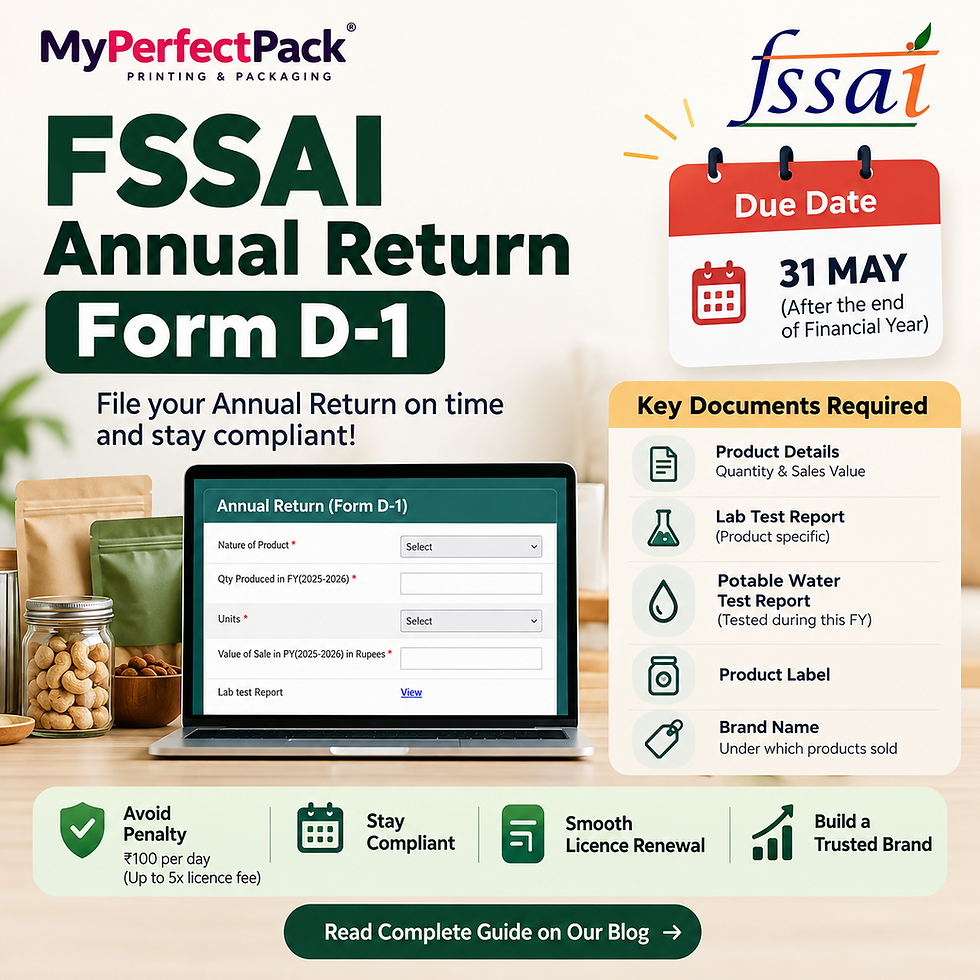
Published by MyPerfectPack | FSSAI Compliance Awareness for Food Businesses
If you manufacture, process, repackage, relabel or import food products in India, understanding FSSAI compliance is essential for running your business smoothly. One important compliance requirement for eligible FSSAI-licensed food businesses is filing the Annual Return in Form D-1.

Many food entrepreneurs focus on obtaining an FSSAI licence but overlook annual returns, food product testing, potable water testing and supporting documents. These requirements should be planned in advance to avoid late fees and compliance-related difficulties.
At MyPerfectPack, we help food entrepreneurs understand packaging, product labelling and related food-business compliance requirements. This guide explains the Form D-1 annual return, the information to prepare, applicable penalties, laboratory reports and the documents shown in the FoSCoS filing process.

1. What is an FSSAI Annual Return in Form D-1?
Form D-1 is the annual return prescribed under Regulation 2.1.13 of the Food Safety and Standards (Licensing and Registration of Food Businesses) Regulations, 2011. It records information about food products manufactured, handled, imported and exported during the relevant financial year.
The purpose of filing is to report the business's food-product activities and related quantities and values to the licensing authority.
According to the FSSAI guidance, licensed food businesses involved in manufacturing—including repacking and relabelling—and importing food products are required to file Form D-1. Manufacturers who export food products are also covered by the applicable annual-return requirements.
Important: This is an annual return for eligible FSSAI licence holders, not a universal filing requirement for every small food business holding only a basic registration.

2. What is the last date for filing Form D-1?
The prescribed annual-return deadline is 31 May following the end of the financial year.
For example:
Financial year covered | Annual-return due date |
FY 2024–25 | 31 May 2025 |
FY 2025–26 | 31 May 2026 |
FY 2026–27 | 31 May 2027 |
The annual return reports the activities of the previous financial year, which runs from 1 April to 31 March.
As this guide is being published in October 2026, the deadline for FY 2025–26 has already passed. Businesses that have not filed that return should check the FoSCoS portal for the filing and applicable late-payment process.
Who files Form D-1, and who files Form D-2?
Form D-1: Applicable to eligible licensed food businesses other than those covered by the separate milk and milk-products return requirements.
Form D-2: Applicable to the specified businesses manufacturing milk and/or milk products, which must submit half-yearly returns for the prescribed periods.
A food business holding multiple licences should check the return requirement separately for each licence. The 2011 Regulations specify a separate return for every licence issued under the Regulations.

3. What is the penalty for late filing of Form D-1?
Under Regulation 2.1.13, delay in filing the annual return attracts a penalty of ₹100 per day beyond 31 May.
FSSAI subsequently issued an order on 10 November 2022 capping the maximum penalty at five times the annual licence fee. The order states that this cap applies from FY 2021–22 onwards.
For example, if the annual licence fee is ₹5,000, the maximum penalty under this cap would be ₹25,000, subject to the applicable rules and the amount determined for the particular filing.
Do not assume that the amount will always be limited to a few hundred rupees simply because the return is only a few days late. Check the applicable late fee displayed by FoSCoS and settle the amount as directed.
Why timely filing matters: Delayed filing may result in a late fee, and the FSSAI order states that the applicable annual-return penalty must be paid before applying for licence renewal.
Official references:
FSSAI Regulations, 2011, Regulation 2.1.13.
FSSAI order dated 10 November 2022 on capping annual-return penalties.

4. What information is required to file Form D-1?
Before beginning the online filing process, keep the following information ready.
A. Business and licence details
Name of the licence holder or business.
Business address.
Address of the authorised premises where the food products are manufactured, repacked or relabelled.
FSSAI licence number.
Relevant licence and business activity details.
Ensure that the information matches the licence and the relevant business records.
B. Product-wise production and sales information
Prepare a product-wise statement for the financial year, including:
Nature or name of each food product.
Packaging type and pack size, such as a pouch, jar, bottle, carton or bulk pack.
Quantity produced or handled.
Unit of measurement, such as kilograms, tonnes, litres or another applicable unit.
Value of sales in rupees.
Import or export quantities and related details, where applicable.
Export destination or port, export price and value, where relevant.
Remarks or other information requested by the form.
The prescribed Form D-1 in the supplied FSSAI Regulations includes columns for food-product name, pack size, quantity in metric tonnes, sale price per kilogram or unit of packing, value, imported/exported quantity, destination, export rate, value and remarks.
Keep the figures consistent. Your production records, sales register, invoices and inventory records should support the information reported in the annual return. Avoid estimating quantities or entering sales values without checking your records.

C. Brand information
The filing screen may ask for the brand under which the products are sold. Enter the brand name associated with the relevant products.
For businesses selling several brands, prepare a clear product-to-brand list before filing. If the portal requires separate information for different products or licences, follow the fields and instructions displayed for the application.
D. Product labels and applicable certifications
Keep a clear copy of the product label ready for upload. The label should correspond to the actual product being reported.
Where applicable, also keep the relevant BIS, AGMARK or Tea Board documentation specified by the portal or the applicable food-safety requirements. These are not interchangeable certificates, and not every food product requires all of them.
5. What laboratory test report is required for FSSAI annual-return filing?
Laboratory testing is an important part of food-safety compliance. The applicable testing requirements depend on the type of food manufactured, the product standards, the business category and the conditions of the licence.
The supplied FSSAI Regulations, 2011, under the Conditions of Licence in Annexure 3, require food businesses to ensure testing of relevant chemical and/or microbiological contaminants at the frequency required based on historical data and risk assessment. The regulations specify testing through the business's own laboratory or a NABL-accredited/FSSAI-notified laboratory, as applicable, at least once in six months under that provision.
Which food-product tests should you arrange?
The exact testing panel must be selected according to the product and its applicable standards. Common examples include:
Product category | Examples of parameters to discuss with the laboratory |
Spices and spice powders | Microbiological parameters, moisture, contaminants and other applicable product-specific requirements |
Nuts and dry fruits | Relevant microbiological parameters, aflatoxins where applicable, contaminants and quality parameters |
Flour, grains and cereals | Moisture, applicable contaminants, microbiological parameters and product-specific requirements |
Ready-to-eat snacks | Applicable microbiological parameters, moisture or other quality parameters, and contaminants relevant to the product |
Edible oils | Relevant chemical and quality parameters, including those prescribed for the particular oil |
Dairy products | Product-specific chemical and microbiological testing, including applicable milk-product standards |
These are examples, not a universal mandatory checklist. For instance, the appropriate tests for cashews will not necessarily be the same as those for turmeric powder, packaged drinking water or edible oil.
Before commissioning a test, provide the laboratory with the product name, ingredients, processing method and applicable food category. Ask for a test panel covering the relevant FSSAI standards and licence conditions.
Which laboratory should conduct the testing?
Choose a laboratory that is appropriately recognised for the required tests. Verify that the laboratory's accreditation or FSSAI notification covers the relevant testing parameters and product category.
Keep the complete report, including the sample identification, test dates, results, laboratory details and applicable accreditation information. The report should correspond to the actual food product and relevant testing period.
Important: The requirement to test products and the requirement to upload a particular report during annual-return filing are not necessarily identical. Follow the documents and instructions displayed in your FoSCoS account, along with the conditions applicable to your licence.
6. Potable Water Test Report: Why is it important?
The screenshot of the annual-return filing screen supplied for this guide specifically highlights a Potable Water Test Report tested during the financial year as an important supporting document.
Food businesses using water as an ingredient or in contact with food must pay particular attention to water safety. Water quality can directly affect the safety and quality of the finished product.
What should the potable water report contain?
The supplied FSSAI Regulations, 2011, Annexure 2, identify an analysis report covering the chemical and bacteriological quality of water used as an ingredient in food. The report should confirm potability and identify the authorised laboratory representative who collected the sample and the date of collection.
For a water report, check the following before uploading:
The report relates to the water source used at the food business premises.
The test panel is appropriate for potable water and the applicable requirements.
The report contains the laboratory name and relevant identification details.
The sample collection date is recorded.
The report identifies the relevant chemical and microbiological results.
The testing laboratory is suitably recognised for the tests performed.
The report relates to the financial year requested by the filing portal.
Which water-testing standard should you ask for?
FSSAI's hygiene guidance refers to potable water meeting BIS IS 10500, with the radioactive parameters excluded in the cited hygiene-rating requirement. The precise testing frequency and applicable exceptions depend on the business and its water source.
FSSAI guidance also describes an exception for potable water supplied by a Municipal Corporation or government body, subject to maintaining water-bill records. Water supplied by a mall, commercial hub, market or private authority may require a report from the relevant supplier according to the applicable requirements.
Do not assume that a water bill automatically replaces a laboratory report in every situation. Check the specific requirement displayed for your business.

How frequently should water be tested?
For food businesses using water as an ingredient, FSSAI's published hygiene guidance specifies testing against BIS IS 10500, excluding radioactive parameters, at least once in every financial year, with at least six months between the two water samples. The cited guidance also describes exceptions for qualifying municipal water supplies.
Because the exact requirement can depend on the water source and business category, confirm the current applicable requirement before arranging the test.
Practical advice: If you are filing the annual return for FY 2025–26, check that your potable water report relates to the period requested for that year. A report from an earlier financial year may not satisfy a portal field that explicitly asks for a report tested during FY 2025–26.
Official references:
FSSAI, Food Safety and Standards (Licensing and Registration of Food Businesses) Regulations, 2011, Annexure 2 and Annexure 3.
FSSAI FoSCoS, sample Water Test Report and published hygiene-rating guidance.
7. How to file Form D-1 on the FoSCoS portal
Eligible food businesses should use the official FoSCoS portal to access the Annual Return facility.
Step 1: Open the Annual Return section
Visit FoSCoS and select the Annual Return option. Follow the portal's instructions for identifying your licence and accessing the return.
Step 2: Enter your FSSAI licence details
Keep your licence number and validity details ready. Verify that you are filing for the correct premises and licence.
Step 3: Select the relevant financial year and product information
Follow the financial-year options available in the portal. Enter the required product details, quantities, units and sales values using your verified business records.
Step 4: Upload the applicable supporting documents
Based on the filing screen supplied for this article, the relevant fields include:
Nature of product.
Quantity produced during FY 2025–26.
Units.
Value of sales during FY 2025–26 in rupees.
BIS/AGMARK/Tea Board documentation, wherever applicable under the displayed requirements.
Laboratory test report.
Brand under which the products are sold.
Product label.
Potable water test report tested during the relevant financial year, where requested.
The portal's requirements can change. Upload the documents requested for your licence and filing, and do not upload an unrelated certificate simply to complete a field.
Step 5: Review the figures and documents
Before submission, verify the following:
The financial year is correct.
Product names match the business records.
Quantities and units are consistent.
Sales values are supported by records.
The uploaded product label matches the product.
The water report corresponds to the required period and source.
Applicable certification documents are valid and relevant.
Step 6: Submit the return and save the acknowledgement
Complete the submission and any applicable online payment process shown by FoSCoS. Download or save the acknowledgement, payment receipt and submitted-return details for your records.
If the portal raises a query or displays a pending requirement, follow the instructions rather than assuming the filing is complete.
8. Common mistakes to avoid when filing Form D-1
Food businesses can reduce compliance problems by avoiding these common errors:
Missing the due date: Set an annual reminder well before 31 May.
Entering incorrect quantities: Reconcile production and sales records before filing.
Using the wrong units: Check whether the field requires kilograms, tonnes, litres or units.
Reporting an unsupported sales value: Cross-check the relevant invoices and sales register.
Uploading an outdated water report: Check the sample collection date and required financial year.
Uploading an unrelated lab report: Make sure the report corresponds to the product and relevant tests.
Ignoring applicable certifications: Verify whether the product requires BIS, AGMARK, Tea Board or other documentation.
Forgetting separate licences: Check whether separate returns are required for multiple licences.
Assuming a basic registration always requires Form D-1: Verify your business category and filing obligation.
Not saving the acknowledgement: Retain evidence of submission and payment.
9. Frequently asked questions
Q1. Is Form D-1 mandatory for every FSSAI registration holder?
No. FSSAI's published FAQ identifies licensed food business operators involved in manufacturing—including repacking and relabelling—and importing food products as requiring Form D-1. Check your actual business category and current portal requirements.
Q2. Do businesses that outsource manufacturing need to file Form D-1?
FSSAI's published FAQ specifically includes relabellers that get their products manufactured by third-party manufacturers. Eligible businesses should therefore not assume that outsourcing manufacturing removes their annual-return obligation.
Q3. Is the penalty ₹100 per day?
The prescribed late penalty is ₹100 per day beyond 31 May, subject to the maximum penalty cap of five times the annual licence fee under the FSSAI order applicable from FY 2021–22 onwards.
Q4. Can one laboratory report cover all products?
Not necessarily. The required parameters depend on the food category and applicable standards. A laboratory should confirm which products and tests are covered by each report.
Q5. Is potable water testing relevant if water is not an ingredient?
The requirement depends on how water is used, the applicable food-safety conditions and the water source. Water used in contact with food or food-contact surfaces may also be relevant to hygiene compliance. Check the requirements for your business rather than assuming that water testing is unnecessary.
Q6. Is a product label required during annual-return filing?
The filing screen supplied for this guide contains an Attach Product Label field. Keep the relevant product label ready and follow the upload instructions displayed for your application.
Q7. What should a business do if it missed the 31 May deadline?
Access the FoSCoS Annual Return facility, check the relevant filing status and applicable late fee, and complete the filing and payment process as instructed. Keep the acknowledgement and payment evidence.
10. MyPerfectPack's compliance awareness checklist
Before filing your annual return, use this checklist to organise the required information.
FSSAI licence number and premises details verified.
Correct financial year selected.
Product-wise production and sales records reconciled.
Quantities and units checked.
Product-wise sales values verified.
Applicable BIS/AGMARK/Tea Board documents prepared.
Relevant laboratory test reports available.
Potable water report checked for the required financial year.
Product labels prepared for upload.
Brand names verified.
Applicable late fee checked and paid.
Submission acknowledgement saved.

Conclusion
Filing the FSSAI Annual Return in Form D-1 is an important compliance activity for eligible food manufacturers, repackers, relabellers and importers. Preparing accurate production and sales data, maintaining relevant food-testing records, checking potable water quality and organising the correct supporting documents can make the filing process more straightforward.
Do not wait until the last few days before the deadline. Maintain your product-wise records and laboratory reports throughout the year so that your annual return can be completed accurately and on time.
Need packaging and labelling support for your food business?
MyPerfectPack offers printing and packaging solutions for food brands, including stand-up pouches, three-side-seal pouches, labels and stickers. We also support businesses with packaging design and related services.
Explore our solutions at www.myperfectpack.com.
Official references for the blog
FSSAI FAQ on Licensing and Registration — covers Form D-1 eligibility, filing deadline and late penalty FSSAI +1
Disclaimer: This article is intended for general compliance awareness and is not legal advice. The filing process and applicable requirements may change. Verify current instructions on the official FSSAI/FoSCoS portal or consult a qualified food-safety professional before filing.


Comments